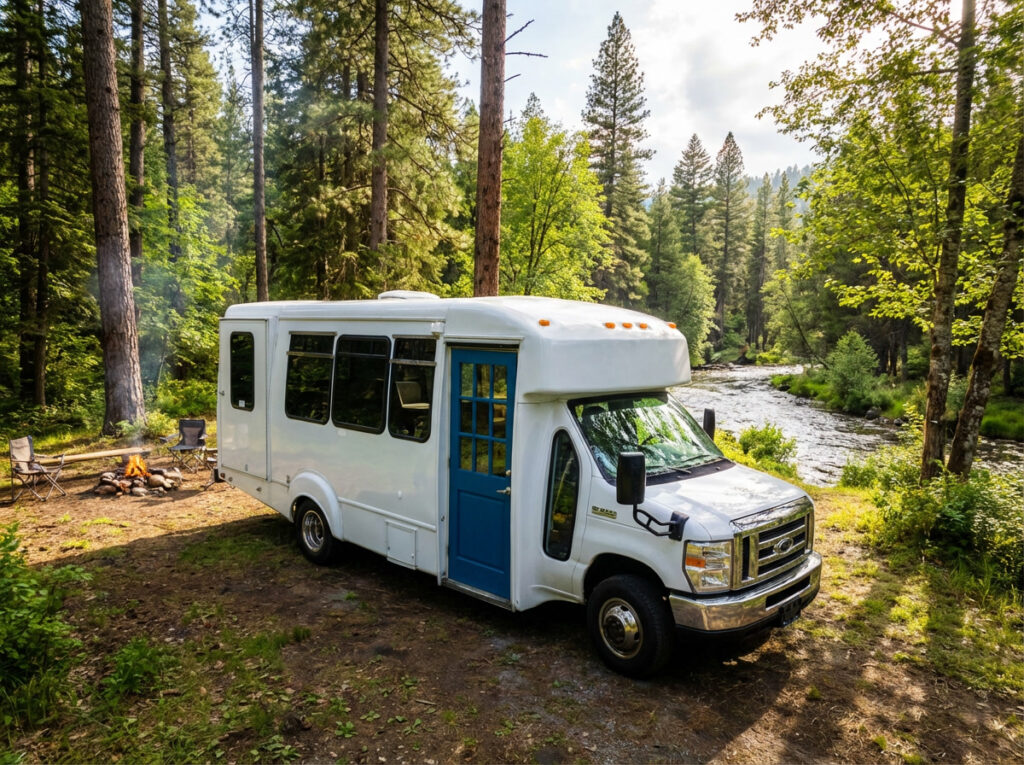
For a long time, I had a persistent itch to take on a bus conversion. The spark really caught fire after watching my neighbor successfully build out a full-sized school bus. It was an incredible project, but seeing it in person confirmed one thing for me: a full-sized rig was just too massive for what I wanted. I needed something nimble, highly drivable, and practical for real-world roads.
Enter my 2009 Goshen Pacer II.
Built on a sturdy cutaway chassis, it hit the exact sweet spot of size and maneuverability I was looking for. The bonus? The previous owner had replaced the standard folding transit door with a traditional house door, giving it a unique, residential character right from the start.
Inheriting a Cross-Country Mystery Box
The bus was sold as an already completed conversion. It had a proud history, having been driven all the way across the United States and deep into Mexico. Knowing the mechanical backbone could handle that kind of mileage was reassuring, but because it came out of North Carolina—a state without mandatory vehicle inspections—it carried a lot of “creative” DIY choices under the hood and behind the walls.
Initially, I was totally willing to live with the layout for a while to see how I liked it, but the bus had an immediate laundry list of known issues:
-
The driver’s seat was completely torn up and wobbled dangerously while driving.
-
The fuel gauge was completely dead.
-
The air conditioning was non-functional.
-
The rear running lights were dark, requiring a total rewire.
-
There was evidence of old water damage from a roof leak that had supposedly been patched.
Still, for a 2009 model that had seen the edges of the continent, the bones felt solid. I knew there would be quirks, but I didn’t realize just how close a look I’d be getting at those quirks until inspection day loomed.
The Inspection Reality Check (and a Flying Door)
Preparing a custom rig for a strict state vehicle inspection is always an adventure, and mine decided to start with a literal bang. On the way to the inspection station, the house-style passenger door completely flew off the bus.
Needless to say, replacing that door is now firmly at the top of the priority list.
Once we actually got it looked at, the true scope of the mechanical work came into focus. Overcoming these hurdles has required a lot of elbow grease, some welding help, and a steady march through the mechanical systems:
Turning a Setback into a Blank Canvas
Between the highway door incident and the necessity of tracing the broken rear light wiring, I hit a turning point. Trying to patch over someone else’s old conversion choices was only going to slow me down.
So, I grabbed the crowbar and gutted the entire interior down to bare metal.
Right now, the Goshen is completely empty. While a blank shell looks intimidating to some, it is exactly where I want to be. Stripping it down has allowed me to chase down every single hidden issue, properly evaluate the old water damage, and ensure the foundation is flawless.
We are incredibly close to checking off the final mechanical boxes—like those ball joints—to get the bus fully inspected, legal, and road-ready. Once the chassis is officially certified, the real fun begins: building out a high-performance workspace from scratch, exactly the way it should be done.
Stay tuned—Phase 1 is almost in the books!